
Shark Attack Club
My Inititiation Into A Club I Didn't Ask To Join

Some clubs you join by choice. You fill out a form, show up with a smile, and prepare for your initiation. Others, you’re dragged into—kicking, yelling, bleeding into the saltwater.
No one asks to join the Shark Attack Club. There are no introductions, no friendly handshakes. Just scars—some visible, some not—and a quiet understanding passed between those who’ve met something ancient and primal in the ocean.
I was formally initiated into the Shark Attack Club on October 2, 2023, and I became an instant statistic: 1 in 11 million. What a lonely club to join.
When it happened, the only other specific people I knew of who had been attacked were Bethany Hamilton—arguably the most well-known shark attack survivor—who lost her arm while surfing at home on Kauaʻi in 2003, when she was just 13 years old, and Mick Fanning, a three-time world champion surfer who survived a shark encounter on live television during a surf contest in 2015. I share mutual friends with both surfers, but I knew my chances of connecting with two of the most recognized faces in the surf world were slim.
Fast forward to last week. My family was on Kauaʻi for Fall Break, schlepping beach gear and surfboards down Kalihiwai Beach to spend the day surfing and hanging with friends. As we laid out our things on the sand, I felt someone looking over from the parking lot. I glanced back and recognized a familiar face. Just to be sure, I quickly Googled: Kevin shark attack Kauaʻi. His photo popped up right away.
It was Kevin Kanehe, a Kauaʻi local who had been attacked by a tiger shark while surfing Hanalei Bay just two weeks after my own incident. He wasn’t as lucky as I was. While I made it to shore with a bitten board, severed leash, cuts from the rocks, and a wild ride on top of a 12-foot Galápagos shark, Kevin was bitten in the leg and sliced on his right hand as he fought off a 12-foot tiger shark.
I told my husband I was going to introduce myself and walked towards the parking lot.
“Are you Kevin?” I asked, somewhat timidly.
“Yeah, that’s me,” he responded kindly.
“I’m Kai. I live on Maui and I’ve been hoping to run into you my past few trips over. I’m the one who got attacked a couple weeks before you.”
He immediately stepped towards me and wrapped me in a hug—long and tight—like I was an old friend he hadn’t seen in years. A silent understanding passed between us.
“Same here,” he said, stepping back and looking into my eyes.
We exchanged stories, talked about our mutual friends, including my old friend Tricia, who had set up his GoFundMe after the attack. I told him I’ve since connected with two other men on Maui who’ve had shark encounters.
I told him I was set up on a “blind surf date” with Bethany Hamilton last October. A mutual friend thought it might help with my healing, so she took us out on her boat to surf Hanalei Bay together. After introductions, Bethany made me laugh by saying, “So you’ve been attacked by a shark, I’ve been attacked by a shark, and here we are, going surfing together in Sharktober!”
I told him I’d still love to meet Mike Coots, another Kauaian who lost his right leg to a shark in October of 1997. He’s since become a shark photographer and advocate. Talking with other survivors helps more than anything.
“Yep,” he nodded. “Bethany and Mike both really helped me when I was in the hospital.”
I admitted something I hadn’t said out loud before—that I’ve always felt a little unworthy of processing my trauma alongside people whose bodies had been bitten. After all, all my shark got were my surfboard and leash.
“Nope,” he said without hesitation. “What you went through was just as real.”
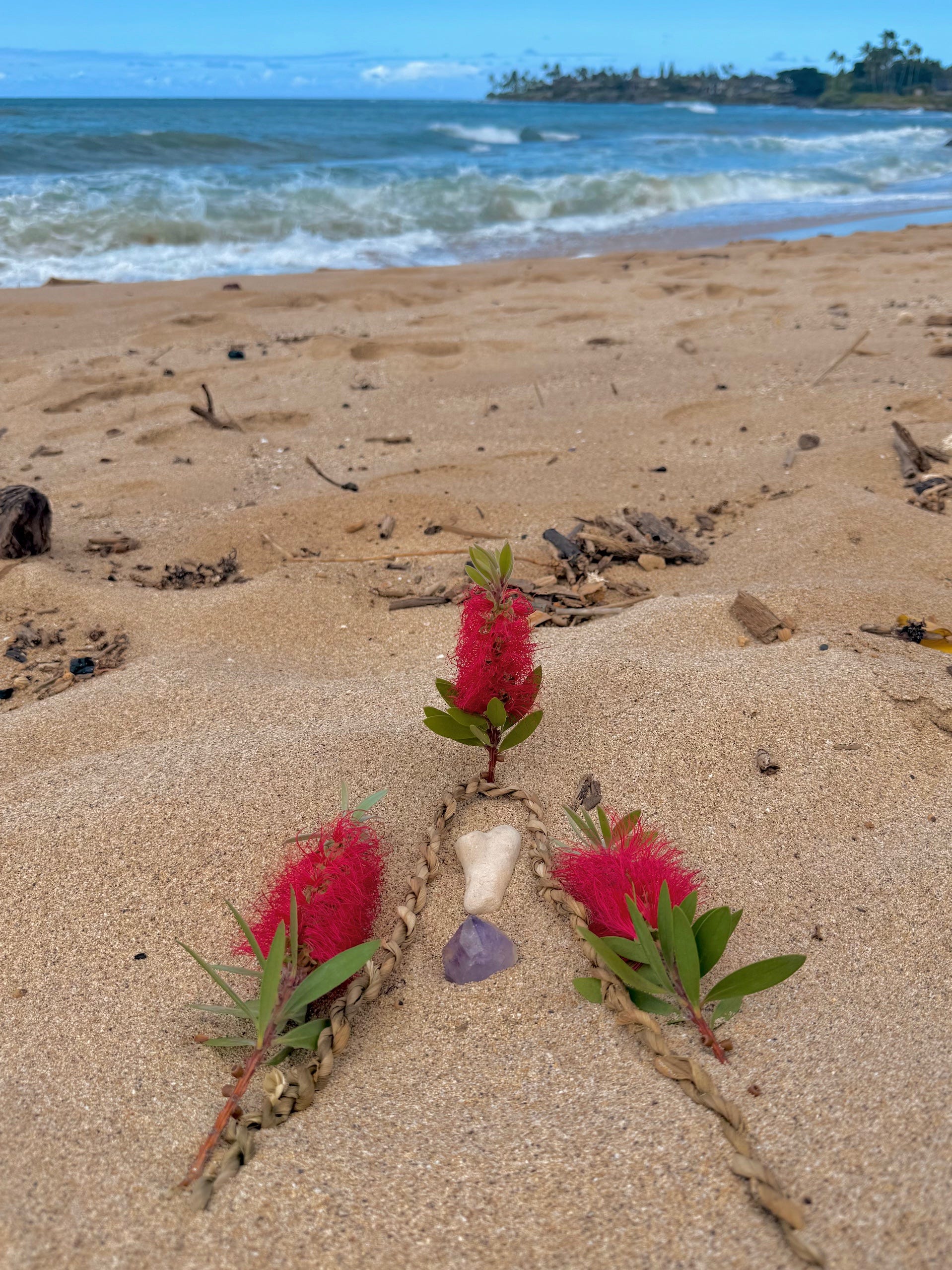
Two weeks ago, on the two-year anniversary of my attack, I went down to Tavares Bay—the place it happened. I set up a small altar: a ti leaf lei, which in Hawaiian culture symbolizes protection, good luck, strength, and healing; a heart-shaped piece of coral; an amethyst crystal for clarity and protection; and three ʻōhiʻa lehua blossoms—one for me, one for my shark, and one for our infinite bond. The ʻōhiʻa lehua symbolizes strength and resilience. After everything I’ve done to heal these past two years, I’ll gladly claim both virtues.
Today is Kevin’s two-year anniversary. I got his number and texted him this morning. I told him how good it was to finally meet, and how I see all the hard work he’s put in—physically and emotionally—to get back in the water.
He replied, “Thank you. Yes, super nice to meet you and talk story. Stay strong. We have a second chance at life and doing what we love—family, surf, gratitude.”
We may not have chosen to be initiated into the Shark Attack Club, but we’ve been given something as rare as the odds themselves: a second chance to walk the shoreline, to surf, to live with intention. Our scars, seen and unseen, don’t just tell stories of survival—they remind us of the raw, untamable beauty of life, and the deep resilience that lives within us.
There’s a sacred thread that ties us together—not by what we lost, but by what we found on the other side: gratitude, connection, and purpose. And in the salt, in the silence, in the swell, we find each other.
Hawaiians have a saying:
E hoʻi i ka wai ʻauʻau o nā kūpuna.
Return to the healing waters of your ancestors.
And that’s what we do.
We are not victims.
We are the tide returning.
Together, still in the water.
Still surfing.
Still here.
I don’t know a braver soul. Lovely essay. ♥️
Kai, your writing is so beautiful and bring me to tears eveey time. I'm so grateful to know you.
Sending you so much love my friend 💜💜💜